
Hi world! Chris here. Keeping in theme with the hiking post last week, I decided to use this week to look at the two-part short story from Hemingway that focuses on a solo trip into nature for some personal healing. While I am personally not a huge fan of Hemingway as a writer nor as a person, I do enjoy that kind of outdoorsy mentality.
If you’re also a fan of being outside or of Hemingway and his words, enjoy! If not, still enjoy because I worked really hard on this essay!
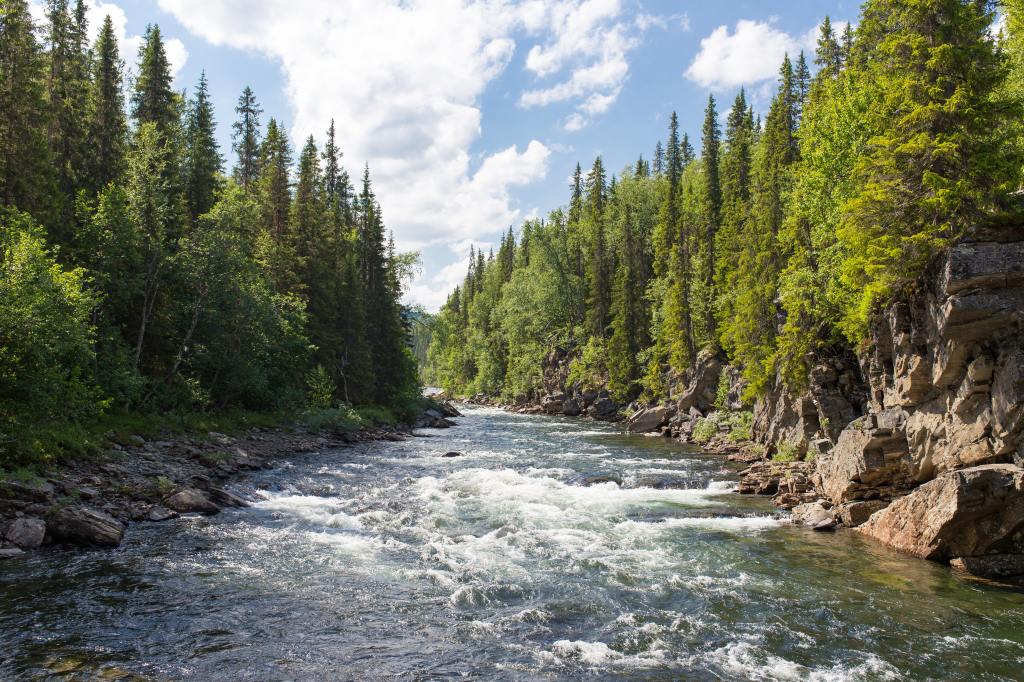
Diving Deep into Hemingway’s “Big Two-Hearted River”
Ernest Hemingway is one of the few authors that is widely considered a man’s man when it comes to the content of his writing. His deep passions for fishing, bullfighting, and drinking are commonly employed as themes in his works; however, depending on the novel or short story, many critics argue that these rituals have nothing to do with being a man. This is most specifically noticed in the two-part short story, “Big Two-Hearted River” that focuses primarily on a solo fishing trip. Through studying the repeated imagery of the river, the metafictional character of Nick Adams, and Hemingway’s omitted ending, one can uncover the different layers of meaning in one of Hemingway’s most popular short stories.
Jennifer Smith wrote an article for the journal Short Fiction in Theory & Practice called “Writing Ritual, Resisting Resolution: The Short Story Cycles of Hemingway and Steinbeck” in which she dedicates an entire subsection to the study of “Big Two-Hearted River.” Smith addresses the fact that Nick is taking this trip to abandon “the need for thinking, the need to write, other needs”, but she also claims this is not true for Nick’s experience on the trip at all (Hemingway, “Big Two-Hearted River” 164). Rather, Smith believes that while the fishing trip is happening in real life, it is also connected to the internal trip Nick, and in some ways Hemingway, is taking “into his consciousness” (178). The idea that this story is more of a mental trip that a physical one is loosely reflected in the Modern Fiction Studies article “Fishing for Stories: What ‘Big Two-Hearted River’ is Really About” by Robert Lamb. Lamb concludes that the river Nick is visiting is a symbol for Nick’s mind just as Smith believes it is “the most famous symbol of consciousness” (180). Both authors agree that this affect is accomplished by the duality Hemingway gives the river.
Described as water that “swirled” and moved “too fast”, the river has a rough and almost dangerous quality about it that is juxtaposed nicely with the fact that it was “smooth” and “made no sound” (Hemingway, “Big Two-Hearted River” 163; 166). These opposing descriptors of peril and peace are exactly what Smith believes marks the river as Nick’s own conflicting mind (180). On the other hand, Lamb attests that the divided nature of the river makes more sense in relation to Nick’s experiences with downstream as “his memory of the past, upstream the future” (178). This is largely based around Lamb’s notion that writers give memories “utilitarian value” as they can become the basis of one’s next project (168). When this is taken into consideration, it becomes clear that Lamb is also agreeing that Nick did not truly come to this place in order to stop thinking and writing, but rather came here for both he and Hemingway to come to terms with thinking and writing.
Nick is a character used so frequently by Hemingway and in such a fashion that his stories have been considered almost autobiographical in some cases (Lamb 166). Both Nick and Hemingway were war veterans that were left with physical and emotional wounds to prompt a need for the conscious meditation Smith and Lamb believe are present in “Big Two-Hearted River.” Perhaps the greatest argument in favor of this analysis comes from the original ending of the short story that Hemingway decided to cut before publication. Hemingway considered the deleted work a “mental conversation” but Lamb considers it the moment “in which [Hemingway] and Nick have nearly become one” (166).
In the omitted pages from the short story, Nick ponders over his past friends, his marriage, and both his writing struggles and his writing goals (Hemingway, “On Writing” 234). Lamb points out that Nick’s friend Bill is “a former Hemingway friend” while Nick’s Ezra is “the poet Ezra Pound” (166). Even Hemingway’s wife Hadley is included as Nick’s wife Helen (Lamb 166). However, the similarities do not end here. Nick also remarks on experiences and beliefs that he shares with his author, effectively making the two indistinctive from each other as the work continues.
As far as Lamb is concerned, these deleted moments are necessary for analyzing the final publication of the work as his conclusion simply would not be possible without the knowledge of how Nick and Hemingway are connected. He argues that in the final version of “Big Two-Hearted River” Nick struggles to hook the second trout because that battle “figuratively represents the efforts of the author to finish the second part of the story” (Lamb 179). The metaphor does not end here but continues as Lamb recounts Hemingway’s thoughts on writing expressed in the original ending. Lamb believes these ideals are present in the edited version of the story as well. For example, the journey Nick takes from the train to his camp is long and difficult enough to symbolize what Lamb calls the “laboriousness of writing” in reference to Hemingway’s lamentation about wanting to write as Cézanne paints (179). This is contrasted with the second part of the story when Nick catches the fish in a way Lamb believes is meant to symbolize “the euphoria that can come from writing” which is another element addressed in Hemingway’s deleted scenes (179).
To offer an opposing view, Smith’s article comes to a conclusion that does not rely so heavily on a reader having access to Hemingway’s original account of “Big Two-Hearted River.” In some ways, she still connects the author to his character, but chooses to focus on Hemingway’s stylistic choices over this detail. Because the short story lacks a structured plot, it also lacks “the sense of resolution a story is supposed to give” (Smith 184). This is a technique Hemingway seems to use throughout the collection of stories from In Our Time as well as his other works. However, Smith argues it is expressed most clearly through the natural imagery inside “Big Two-Hearted River” and thus, concludes that is one of the main points of the story. Rather than include the long and drawn out omitted scenes of Nick’s thoughts, Smith believes Hemingway chose to “use the natural world to identify and comment on narrative ruptures” (179).
These ruptures are echoed in the aforementioned descriptions of the river as it shifts from something tranquil to something threatening in the same way Nick’s inward narrative shifts as he passes over the land. He greets the “burned-over stretch of hillside” with a glum narrative that unexpectedly lifts as Nick watches “the trout move” (Hemingway, “Big Two-Hearted River” 163; 164). Lamb believes “the emotion of the scene is expressed by the structure of the landscape” which inadvertently supports Smith’s ideals that Hemingway chose to focus more on fishing than conscious writing to portray his meaning, going against Lamb’s apparent belief that the stream of conscious writing was necessary for the final version to have any meaning (176).
The disagreement between the two articles ends here as they both share a similar belief in Hemingway’s use of the swamp at the end of the story. Because the river and its waters are Nick’s thoughts and memories, the swamp is a symbol for those he is not ready to explore yet (Smith 183). Nick himself admits “he did not want to go in there” despite the fact that he could catch large trout (Hemingway, “Big Two-Hearted River” 180). For both Lamb and Smith, this hesitation is a reflection of Hemingway’s confidence as a writer. Lamb believes that the trout themselves symbolize stories Hemingway is able to “catch” while Smith concludes that fishing is a metaphor for exploring one’s consciousness and finding the stories there (179; 184). Either way, they both agree this is Hemingway making a reference to where he is as a writer and where he will go in the upcoming days. Until then, “Big Two-Hearted River” is meant to make one think of “the stories those days will bring” (Smith 184).
No matter the original intent of the piece, it is interesting to see the complexities others have implied. It is clear from the deleted scenes that Hemingway was having deep considerations about himself as a writer while he wrote this, but it is hard to believe a man that so vehemently criticized Joyce for using tricks in writing would rely so heavily on symbolism and metaphors to convey his true meanings. There is certainly an element of consciousness in the way Nick considers the river and it can be widely assumed his thoughts were meant to mirror Hemingway himself. However, because Hemingway did make the decision to omit the scenes that made this so clear, it is altogether possible he wanted this to be a short story that purely focused on fishing. With so many possible layers to unfold, it is no surprise that “Hemingway considered it by far the best story he had written to that point” just as many others do too (Lamb 162).
Citation
Hemingway, Ernest. “Big Two-Hearted River.” The Complete Short Stories of Ernest Hemingway, Scribner, 2003, pp. 163-180.
Hemingway, Ernest. “On Writing.” The Nick Adams Stories, Edited by Philip Young, Scribner, 1972, pp. 233-241.
Lamb, Robert Paul. “Fishing for Stories: What ‘Big Two-Hearted River’ is Really About.” Modern Fiction Studies, vol. 37, no. 2, 1991, pp. 161–181.
Smith, Jennifer J. “Writing Ritual, Resisting Resolution: The Short Story Cycles of Hemingway and Steinbeck.” Short Fiction in Theory & Practice, vol. 3, no. 2, Oct. 2013, pp. 175-191.

Sorry for the long post, but if you made it this far, thanks for reading! I’ll try to keep it simple next week.
Until then, stay safe out there!
 Here, There, and Back Again